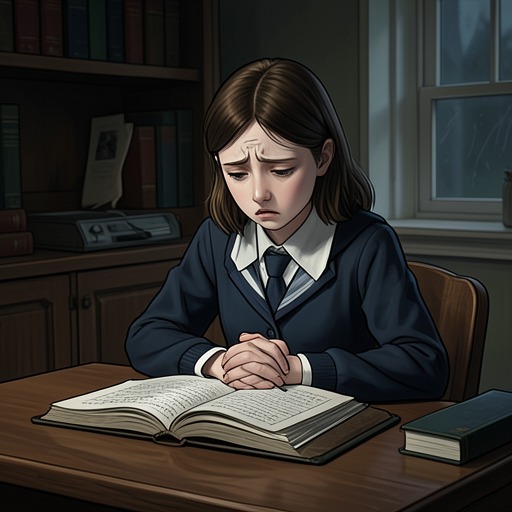
Ms. Norbury
Mean GirlsMs. Norbury is a teacher at North Shore High School whose role shifts between comic embarrassment, academic authority, and reluctant leadership. Her encounters with Cady Heron trace that range: she responds kindly when Cady is flustered in class, later confronts her failing grade, and ultimately guides the students through the damage caused by the Burn Book. Her movement from being one of its targets to leading a response—and then forgiving Cady without absolving her—makes her a measure of the consequences the students’ cruelty has beyond their own social world.
Identity and Introduction
During Cady’s first homeroom, Ms. Norbury is introduced through an accident that makes her vulnerable in front of the class. Cady spills a box of Dunkin’ Donuts, papers, and much of a large takeaway coffee over the woman she has identified as the teacher. Rather than blame Cady, Ms. Norbury bends down to help gather the mess and says, “I’m bad luck.” Her short dark hair, horn-rimmed glasses, and mousy-pretty appearance distinguish her from the students who are watching the mishap unfold.
The embarrassment escalates when Ms. Norbury tries to remove her stained sweater and her T-shirt catches with it, leaving her partly undressed in front of the class. Cady recognizes her aloud; Principal Duvall is standing in the doorway as Ms. Norbury realizes what has happened and asks whether her T-shirt is stuck to the sweater. The episode establishes her as a figure exposed to the same public scrutiny that shapes student life, but her first response to Cady is assistance, not punishment.
Teaching and Academic Authority
In calculus, Cady’s attention wanders toward Aaron Samuels when Ms. Norbury calls on her. Cady answers with an admiring remark about him before recovering with the mathematical answer, and Ms. Norbury looks pleasantly surprised, confirms that the answer is right, and moves the class on to homework. Her response treats Cady’s mistake as recoverable: she acknowledges the correct work rather than extending the moment of embarrassment.
That early encouragement contrasts with Ms. Norbury’s later concern when Cady’s performance deteriorates. After returning quizzes, she taps Cady on the shoulder and asks whether she understands the material. When Cady is about to respond, Ms. Norbury lays down a quiz scored 77. Later, as Cady tries to catch up with Aaron after class, Ms. Norbury stops her and hands her a new quiz scored 58, a D. She asks Cady to have her parents sign it so they know she is failing, and her voice conveys disappointment. The falling scores make Cady’s pretense of being bad at math visible to a teacher who has already shown that she notices both her ability and her decline.
The Burn Book Crisis
When the Burn Book’s accusations erupt into a schoolwide confrontation, Ms. Norbury is caught in the middle of the conflict. She tries to separate two girls and is knocked to the ground; her glasses fly off. On getting them back, she sees the page that labels her a “Sad Old Drug Pusher.” Cady’s account registers the sight as painful: Ms. Norbury appears sad and defeated, and the insult briefly makes Cady feel close to regretting what she and her friends wrote. The book’s cruelty has reached beyond student rivalries and made a teacher its target.
The broader disorder continues between periods, after Regina George has circulated the book while students were in class. As accusations turn into violence, Ms. Norbury is again thrown down. Coach Carr restrains Trang Pak and Sun Jin Dinh, while Principal Duvall approaches with a baseball bat. These scenes place Ms. Norbury among those harmed by the book’s release, not safely outside the conflict as an observing authority.
Leading the Students
After Principal Duvall struggles to respond to the girls’ grievances, he turns to Ms. Norbury and presents her as intelligent, successful, graceful, and caring. Her doubtful reply—“I am?”—makes clear that she does not simply claim the authority he assigns her. Still, when he asks her to help the students with their self-esteem, she steps forward reluctantly and asks everyone to close their eyes.
Her exercise begins by asking students to raise a hand if a girl has ever said something bad about them behind their backs. She then challenges the language that has circulated through the book: calling one another whores and sluts, she argues, normalizes those words for boys to use as well. When she asks who has ever been called a slut, hands rise gradually until the response is widespread; even Joan the Secretary raises hers. Ms. Norbury turns the students’ attention from the spectacle of individual accusations toward a shared pattern of harm, linking what they say about one another to the language they permit others to use.
Accountability and Forgiveness
After Regina is injured in a bus accident, Cady begins trying to make amends at school. When she brings a completed calculus quiz to Ms. Norbury, the teacher greets her with a pointed reference to the Burn Book’s false drug accusation: “Did you want to buy some drugs?” Cady accepts the rebuke and apologizes for what she wrote. Ms. Norbury reminds her that the accusation led to police searching her house, then asks how much trouble Cady got into for telling the truth. Her anger is real, but so is her willingness to recognize Cady’s admission.
Ms. Norbury also makes clear that Cady was not the only person who wrote in the book, asking whether she told Principal Duvall who else had contributed. The question places confession within a wider demand for accountability rather than allowing Cady’s apology to stand in for everyone’s responsibility. When Cady apologizes again, Ms. Norbury says, “I forgive you,” but attaches a consequence: she has worked out how Cady will earn extra credit. The closing exchange joins compassion to standards. Forgiveness repairs the teacher-student relationship without erasing the damage, and the extra-credit assignment—likely to involve the Mathletes—returns Cady to the academic life she had been neglecting.